

Two Big Trials, One Clear Answer
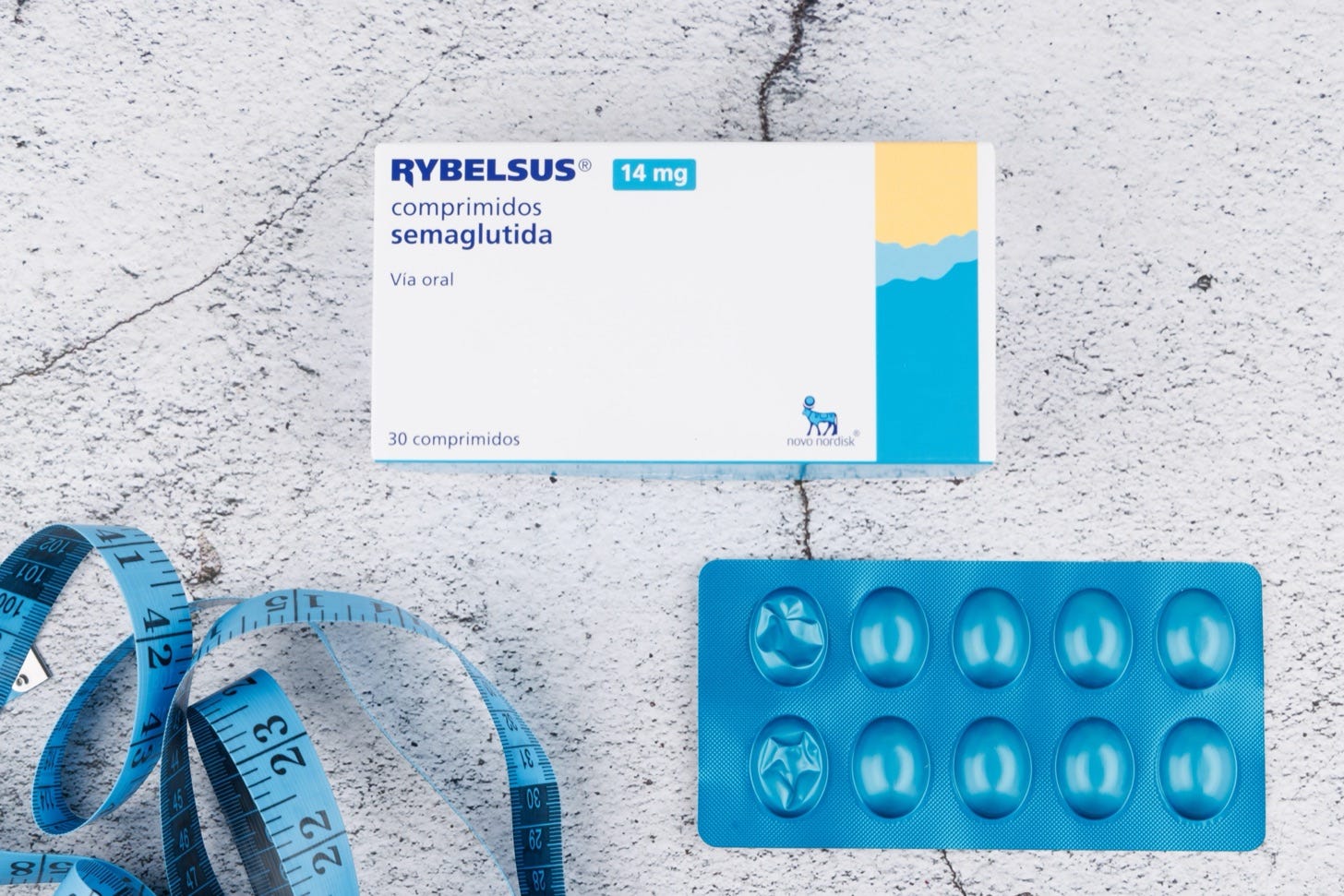
For two years, 3,808 people in the early stages of Alzheimer’s took either a daily pill of semaglutide, the drug inside Ozempic, or a placebo. By the end, memory and daily life declined at the same pace in both groups. Those results come from two final-stage trials, evoke and evoke+. The headline result came out last December, and the full paper from Alzheimer’s researcher Jeffrey Cummings and colleagues, published in The Lancet in March, confirms it. Families everywhere wondered whether medicine’s most talked-about drug could help a parent’s brain. Now there’s a clear answer.
The hunch made real sense. Drugs in Ozempic’s class, called GLP-1 drugs, do more than lower blood sugar and weight. Studies following people who already took them suggested lower rates of dementia, and lab work suggested they calm inflammation. Since an Alzheimer’s brain wrestles with both inflammation and energy trouble, easing both looked like a smart bet.
The body responded. Memory didn’t. Novo Nordisk, which makes Ozempic, ran both trials in adults aged 55 to 85 who had early Alzheimer’s and confirmed amyloid, the plaque protein. After two years, the main score of memory, thinking, and daily life showed no meaningful gap between the pill and the placebo. Other tests stayed flat too. Yet one thing moved right on cue: a blood marker of inflammation fell, just as the theory predicted, while thinking refused to follow (News-Medical).
It won’t slow early Alzheimer’s. For a parent with early symptoms, these trials cross one big hope off the list: adding the semaglutide pill didn’t slow the disease. For someone already taking semaglutide for diabetes or weight, the trials raised no new safety worries. Serious side effects, deaths included, were about as common as on the placebo, while nausea, lower appetite, and weight loss were more common on the pill.
Trial extension called off. Because the pill showed no benefit over two years, Novo Nordisk canceled the planned one-year extension (Alzheimer Europe). Still, every volunteer in both trials already had symptoms and plaque buildup. Whether GLP-1 drugs help prevent dementia years earlier, before symptoms start, wasn’t tested here.
Know someone asking this? Forward this email, or send them this edition’s page.
Trial Watch
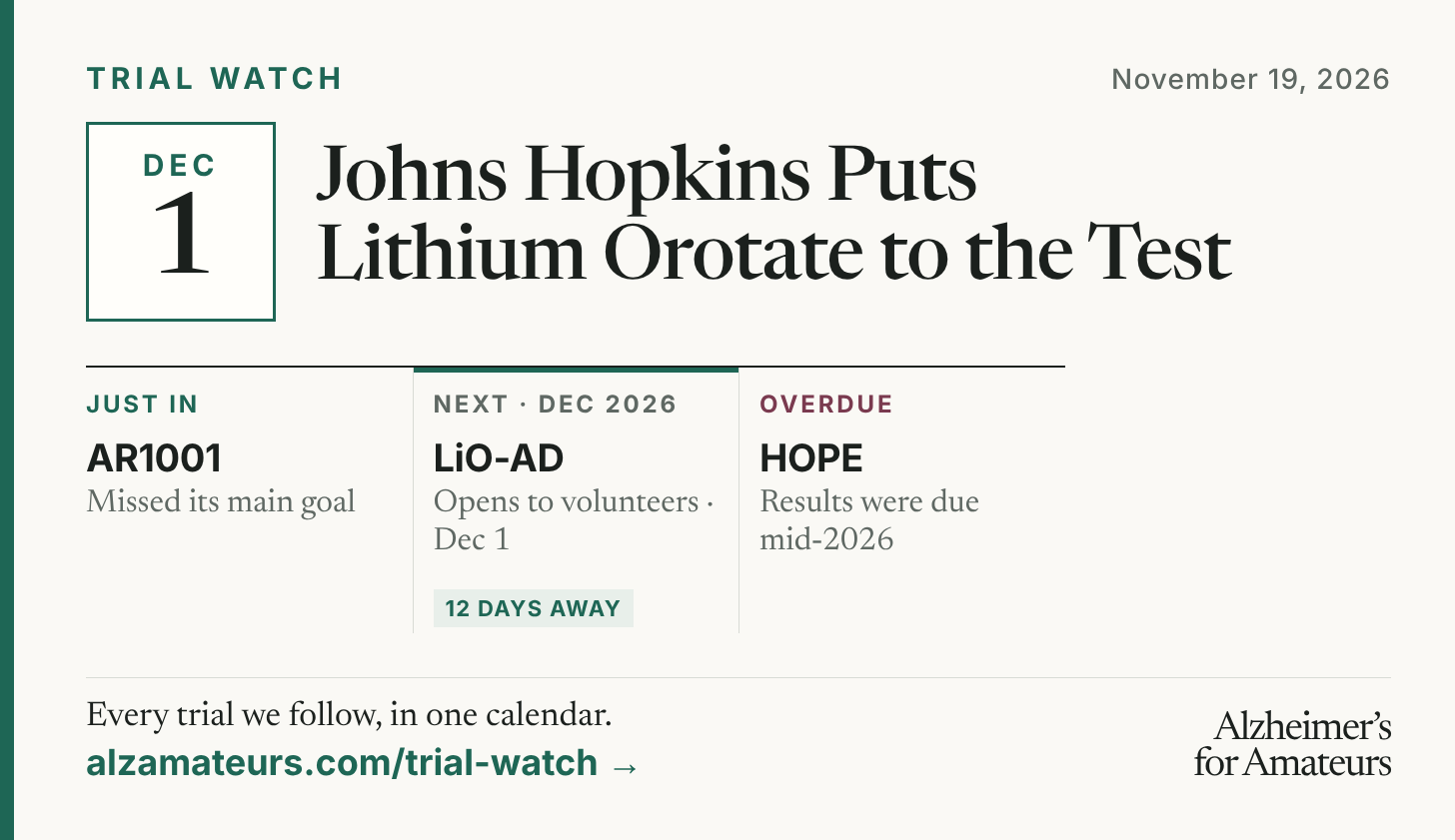
The first real test of lithium orotate is about to open, and two pills that families have been watching just reported.
Lithium orotate starts its first test. LiO-AD, a 40-person Johns Hopkins trial of the over-the-counter supplement against a placebo, is expected to start recruiting on December 1 (ClinicalTrials.gov). It runs nine weeks and asks whether the supplement reaches the fluid around the brain and whether people tolerate it, not yet whether it helps memory. That makes it the first step toward a real answer for families already buying it. Our lithium orotate review has what’s known so far.
Two pills reported at CTAD, the research meeting in Boston on November 16 and 17, and neither gave a clean yes.
AR1001 missed its main goal. AR1001 (mirodenafil, from the same drug family as Viagra) didn’t slow decline more than a placebo across all 1,535 people in its final-stage trial. The company points to one group: the 604 people not already taking an older Alzheimer’s drug. In them, the main memory-and-daily-life score declined 0.44 points less over a year, which the company calls 31 percent slower. The trial named that group in advance, but these are the company’s own numbers, and the full data isn’t out yet (AriBio). More people quit the pill over side effects, mainly stomach trouble, than quit the placebo. AriBio plans to discuss the results with the FDA.
PRI-002 missed. PRI-002, a daily pill designed to break up small toxic clumps of amyloid, didn’t slow decline more than a placebo at 48 weeks in 304 people. Priavoid will show the full data at meetings in 2027 (Priavoid).
Roundup
A gentler start, less brain swelling. Donanemab (Kisunla) is a drug given by drip that clears amyloid. Starting it on a slower dose schedule cut ARIA-E, the brain swelling these drugs can cause, by about a third in the TRAILBLAZER-ALZ 6 trial. In people with two copies of APOE4, the gene variant that raises both Alzheimer’s risk and swelling risk, it fell from 57 percent to 24 percent (Alzforum). Swelling risk is the main thing that makes families hesitate over these drugs.
A common agitation drug was linked to more strokes. Risperidone is often prescribed for severe agitation in dementia. A study published last year in the British Journal of Psychiatry looked at NHS records of more than 165,000 people. Those on risperidone had more strokes, even with no stroke history: 2.9 percent against 2.2 percent (Brunel University of London). NHS guidance already limits it to six weeks for severe symptoms, which makes it a fair thing to raise at the next appointment.
A prevention vaccine got Fast Track. AV-1959R, from Nuravax, is a vaccine meant to teach the body to fight amyloid on its own. It’s for people who have the plaque protein building up but no symptoms yet. The FDA gave it Fast Track, which means more contact with the agency and a possibly quicker review, not approval (Nuravax). A first trial in 16 people, published in Molecular Neurodegeneration, found it safe, and everyone who got the vaccine made antibodies; a trial of about 160 people, called AREVIA, comes next.
Spotted in the Wild
Watch: Louisa Nicola on creatine, The Diary of a CEO
Creatine for the brain, on The Diary of a CEO
Creatine has had a big year. Neuroscientist Louisa Nicola’s pitch for it as brain protection on The Diary of a CEO (the clip) passed 1.1 million views. It’s easy to see why: it’s cheap, it’s familiar from the gym, and it’s about energy.
The brain-fuel pitch. Brain cells burn through a lot of energy, and creatine helps cells recycle it. Nicola and other supporters argue that topping up that supply should help protect aging brains.
The evidence is small. The only Alzheimer’s trial is a pilot from the University of Kansas: 20 people for eight weeks, with no comparison group (Alzheimer’s & Dementia: TRCI). A new six-week trial in 58 healthy adults tried GAA, a building block the body turns into creatine, alone or with creatine: some recall times got faster, and most memory tests didn’t move (PubMed). Research in people with kidney disease is thin, so that’s one group to talk to a doctor first (Mayo Clinic). The trial that would settle it, a real controlled test in people with Alzheimer’s, hasn’t been done.
Want to dig deeper? The papers and readable accounts behind this edition are gathered on the alzamateurs.com edition page.
Written by AI and directed by Tony Rosen. How this newsletter is made.