
An AI project by Tony Rosen.
Lead from Decades Ago May Still Be Counting against the Brain
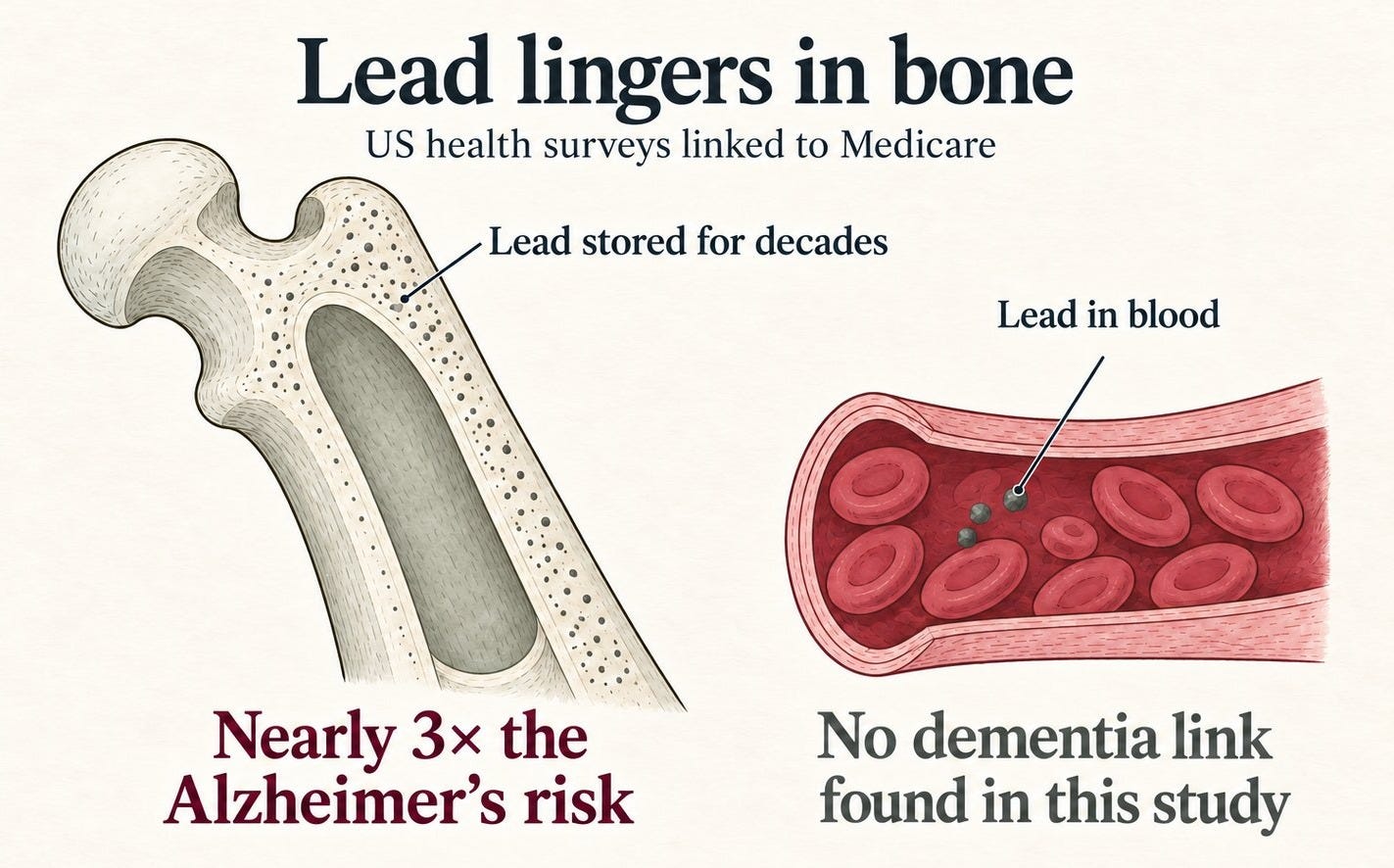
Older Americans with the most lead stored in their bones had nearly three times the Alzheimer’s risk of those with the least, in US health surveys linked to Medicare.
Most of the people studied were born before 1980, when leaded gasoline and lead paint were part of everyday life. Leaded gasoline for cars wasn’t banned in the US until 1996. Bone kept what the years left behind. “Once lead enters the body, it can remain stored in the bones for decades,” says Xin Wang, the University of Michigan epidemiologist who led the study.
That’s why the two kinds of lead told different stories. Blood lead mostly shows recent exposure, and it had no link to dementia. Bone lead, a lifetime’s record, did. No bones were actually scanned: computer models estimated bone lead from blood lead, age, smoking, and other clues, across up to 30 years of records.
If the link holds, it’s a big one. The model ties about 18 percent of new US dementia cases a year to lifetime lead, roughly 90,000 people. It’s an association, and people with more lead may differ in other ways, such as income or where they lived.
The researchers’ answer is an old one: clear lead from paint, pipes, and soil. That won’t reach the lead already stored in older bones. It protects whoever grows up next.
Gist: Older Americans with the most lead stored in their bones had nearly three times the Alzheimer’s risk of those with the least. Recent lead in the blood showed no link.
Evidence: Records of thousands of people from national health surveys, linked to Medicare. Bone lead was estimated by computer models, not measured. An association, not proof of cause.
Origin: Xin Wang, Kelly Bakulski, and Sung Kyun Park at the University of Michigan School of Public Health. Alzheimer’s & Dementia, 2026.
Why would lead hide in bones? The body stores lead in bone, where it can stay for decades. A blood test mostly shows recent exposure, so it can miss a lifetime’s worth.
How did they know how much lead was in people’s bones? They didn’t measure it. They used machine learning, computer models that learn patterns from data. The models estimated it from blood lead, age, education, job, body size, and smoking. Those estimates match real measurements only moderately well.
Where does lead still come from? The researchers name old paint, old pipes, contaminated soil, and industrial sites.
Can someone find out their own bone lead? Not easily. Bone lead is measured with a special X-ray scan that only a few research centers have. A blood lead test is common, but this study suggests it isn’t the number that tracks dementia.
Does this mean lead causes Alzheimer’s? Not on this evidence alone. The people with the most lead may differ in other ways, such as income or where they lived, and the models can only adjust for what was recorded.
Want to dig in? The University of Michigan’s write-up explains the bone-versus-blood point. The paper is in Alzheimer’s & Dementia.
The Roundup
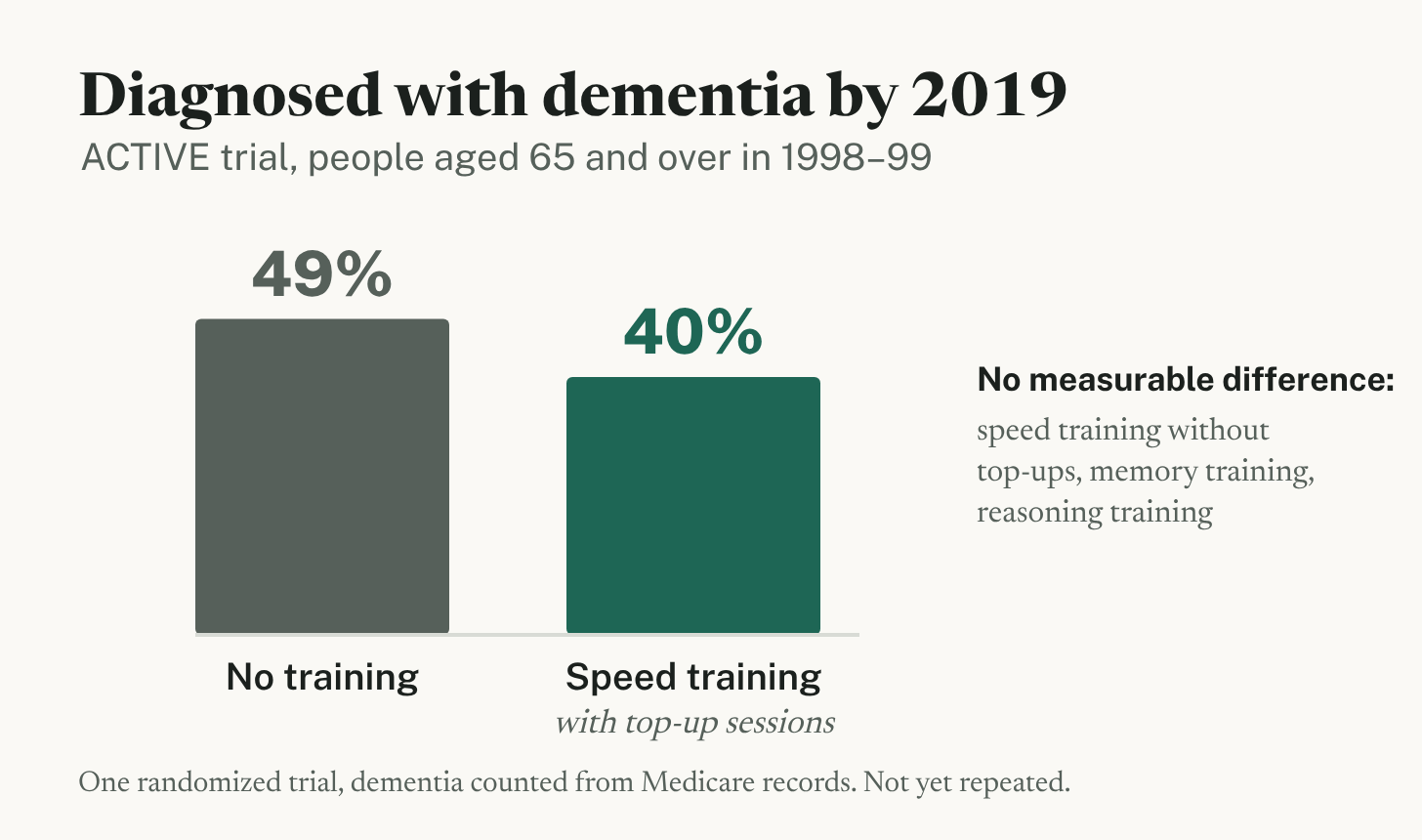
A few weeks of computer speed training in the late 1990s, plus a few top-up sessions, came with fewer dementia diagnoses 20 years later: 40 percent, against 49 percent with no training. The ACTIVE trial randomly assigned 2,802 people aged 65 and over to memory, reasoning, or speed training, or none, and followed them through Medicare records. Only speed training with the top-ups made a measurable difference. That result was one of more than 20 comparisons, so it needs a trial built to test this single question. A later version of the task is sold today as “Double Decision,” part of BrainHQ; one of the study’s authors consults for the company that sells it.
People with the most reading and learning across their lives were diagnosed with Alzheimer’s later: at 94, on average, instead of 88. Rush University followed 1,939 older adults. The top tenth for “lifetime enrichment” (books at home as a child, a library card in midlife, chess and puzzles later) were diagnosed later than the bottom tenth. It’s an association, and people recalled their childhoods decades later. In donated brains, enrichment didn’t mean fewer plaques and tangles, but it still came with better thinking near the end of life.
Blood tests for dementia held up in six Latin American countries, where such tests are rarely studied. In 605 people from the ReDLat research network, four blood markers helped identify Alzheimer’s and frontotemporal dementia, a type that often changes behavior first. Adding brain scans and memory tests raised accuracy further. Most blood-test research comes from high-income countries, and a test is only as good as the people it was checked on.
Switching off one enzyme in the neurons of mice cut Alzheimer’s plaques. At Indiana University, Jungsu Kim and Hande Karahan removed an enzyme called IDOL in mice bred with human genes for Alzheimer’s-like disease. Plaques fell, and so did APOE, a protein tied to Alzheimer’s risk. The surprise was where it worked: the team expected immune cells to matter most, not neurons. No drug targets IDOL yet.
An inexpensive seizure drug kept neurons from making the stickiest form of amyloid, in mice and in human cells. Jeffrey Savas’s team at Northwestern found that levetiracetam slows how neurons recycle parts of themselves, steering them away from making amyloid-beta 42, the form that clumps into plaques. It would have to start years before symptoms. “You couldn’t take this when you already have dementia,” Savas says. It’s a prescription drug for seizures, and this is no reason to start or stop it.
Trial Watch
Results now expected from early 2027: Bristol Myers Squibb’s ADEPT trials of Cobenfy for psychosis in Alzheimer’s, meaning the hallucinations and delusions many families deal with. Cobenfy, a pill that pairs xanomeline with trospium, is already approved for schizophrenia. Nothing is approved for Alzheimer’s psychosis. In December 2025, the company dropped data from a few trial sites over “irregularities.” In July 2026, it pushed results from all three ADEPT trials into 2027, citing slow enrollment.
Spotted in the Wild

“The disease that starts in your 30s but kills you in your 70s.” That’s how The Diary of a CEO, one of the world’s biggest podcasts, billed its two-hour episode with Louisa Nicola, a neurophysiologist and performance coach. It has about 2.7 million views. What’s true: Alzheimer’s brain changes can begin 3 to 10 years before symptoms, and some more than 30. The 2024 Lancet Commission estimated that up to 45 percent of dementia could be delayed or prevented by tackling 14 risks that can be changed, such as hearing loss and high blood pressure. “Starts in your 30s” is a hook, not a finding.
Watch: Cognitive decline expert: the disease that starts in your 30s but kills you in your 70s
The Diary of a CEO, with Louisa Nicola. Two hours long. YouTube’s thumbnail currently shows a different hook, about creatine.
Worth Watching
Watch: Study finds brain training games may help protect against dementia
NBC News. A news segment on the 20-year speed-training result. Watch for “brain games” in general: only speed training, with boosters, made a difference.
Caregiver Reset
This one is for the person doing the caring. In a small University of Michigan study, 36 city dwellers took a “nature pill”: time somewhere that felt like nature, at least three times a week for eight weeks. Saliva tests showed cortisol, a stress hormone, falling during those breaks, and the best return for the time came at 20 to 30 minutes. People chose the place, the time, and how long. It was a small study without a comparison group, so take it as permission more than proof.

What We Got Wrong
A fact check of the September 29 edition found three claims its sources don’t support.
The finger-prick test. That edition gave its accuracy as “86 percent against 98.” There is no 98 in the study. The 86 percent is how well a mailed finger-prick sample picked up the Alzheimer’s changes seen in spinal fluid, in 337 people at seven European centers. It’s still a research tool, not a test anyone can order.
Calcium alpha-ketoglutarate. That edition said this healthy-aging molecule worked “more strongly in females.” The study doesn’t support that. What holds up: it restored memory connections in mice bred to have Alzheimer’s-like disease. There is no trial in people.
Body weight and vascular dementia. That edition said extra weight raised the risk by “roughly 50 to 60 percent,” and repeated that number in its own corrections. The genetic study found about 63 percent higher odds for each step up in genetically predicted weight. What holds up is the more useful half: most of the effect ran through blood pressure, which medicine can already treat.
Want to dig deeper? The main sources behind this edition, plus a few more good reads, are gathered on the alzamateurs.com edition page.